By Joseph Ibrahim Bahme Sankoh
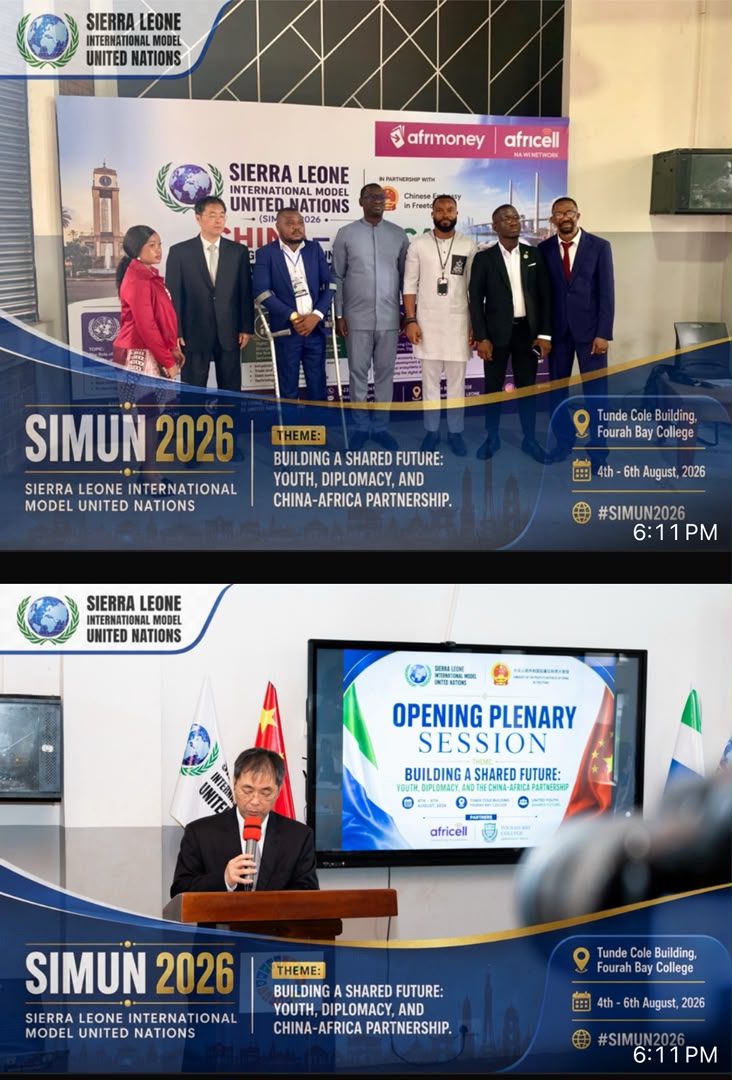
The Sierra Leone International Model United Nations (SIMUN) in partnership with the Chinese Embassy in Freetown, successfully hosted the China–Africa Youth Dialogue & Model United Nations Conference 2026 from 4–6 August 2026 at the Tunde Cole Building, Fourah Bay College, bringing together young leaders, diplomats, academics, development practitioners and other stakeholders for three days of dialogue, diplomacy and leadership development.
Held under the theme “Building a Shared Future: Youth, Diplomacy, and China–Africa Partnership,” the conference sought to position young people at the centre of conversations about international relations, sustainable development and the future of China–Africa cooperation.
The conference featured three principal committees: the United Nations Security Council (UNSC), the General Assembly First Committee, and the Economic and Social Council (ECOSOC). Through the Model UN simulation, delegates represented different countries, researched national positions, engaged in diplomatic negotiations and developed policy-oriented solutions to contemporary global challenges.
The UNSC examined China’s role in supporting peacekeeping, stability and conflict resolution in Africa, while the General Assembly First Committee focused on strengthening China–Africa cooperation under the Belt and Road Initiative to accelerate the Sustainable Development Goals. ECOSOC explored China–Africa collaboration in education, digital innovation and youth empowerment.
Beyond the simulation itself, the conference provided a platform for young Sierra Leoneans to engage with broader questions concerning education, technology, entrepreneurship, international cooperation and leadership.
A central message emerging from the conference was that Africa’s youth should not be regarded merely as beneficiaries of development, but as active partners in shaping the continent’s future. With Africa’s young population growing and the global economy becoming increasingly digital and interconnected, investment in education, skills, innovation and leadership development remains critical.
The partnership with the Chinese Embassy in Freetown added an important diplomatic dimension to the conference. It provided an opportunity for young participants to examine China–Africa relations from a youth perspective and to explore how international partnerships can contribute to education, technology transfer, innovation, entrepreneurship and sustainable development.
The conference also featured distinguished speakers like Ambassador Zhao Yong, the Ambassador of the People’s Republic of China to Seirra Leone, who contributed perspectives on leadership, development, and youth empowerment. Dr. Ibrahim Bangura, Economist, Development Specialist and Policy Advisor, addressed participants on “Empowering Africa’s Youth Through Innovation, Education, and Inclusive Economic Growth in the China–Africa Era.” Pst. Frank Anih, General Overseer of Grace of God Mission Freetown, also contributed to discussions on character, integrity, purpose and responsible leadership. And a host of other distinguished speakers.
An important component of the conference was the recognition of outstanding delegates. SIMUN adopted a balanced selection approach in which one outstanding delegate would be recognised from each of the three committees, resulting in three outstanding delegates. They would subsequently be accompanied by one SIMUN official, making a total delegation of four. The approach was designed to ensure fairness across committees while creating opportunities for further international exposure and leadership development.
The conference demonstrated that Model United Nations can serve as more than an academic simulation. It can function as a practical platform for developing negotiation, public speaking, research, critical thinking, diplomacy and coalition-building skills among young people.
However, the conclusion of the conference also raises a more important question: what happens next?
For SIMUN, the ultimate measure of success will be whether the relationships and ideas generated during the conference translate into sustained youth networks, educational exchanges, innovation, entrepreneurship, policy engagement and people-to-people diplomacy.
The China–Africa Youth Dialogue therefore represents not an endpoint, but a foundation for continued engagement.
As Sierra Leone strengthens its international partnerships, the country will require a new generation of leaders capable of representing its interests with competence, confidence, integrity and a genuine commitment to public service.
The 2026 SIMUN conference has contributed to that objective by giving young people an opportunity to experience diplomacy not simply as a concept, but as a practice.
The future of diplomacy requires dialogue. The future of development requires partnership. And the future of both requires young people prepared not only to lead, but to serve.
About the Author:
Joseph Ibrahim Bahme Sankoh is the Founder and Chief Executive Officer of the Sierra Leone International Model United Nations (SIMUN), with a focus on youth leadership, diplomacy, civic engagement and international affairs.