By Kadijatu Bangura D.S
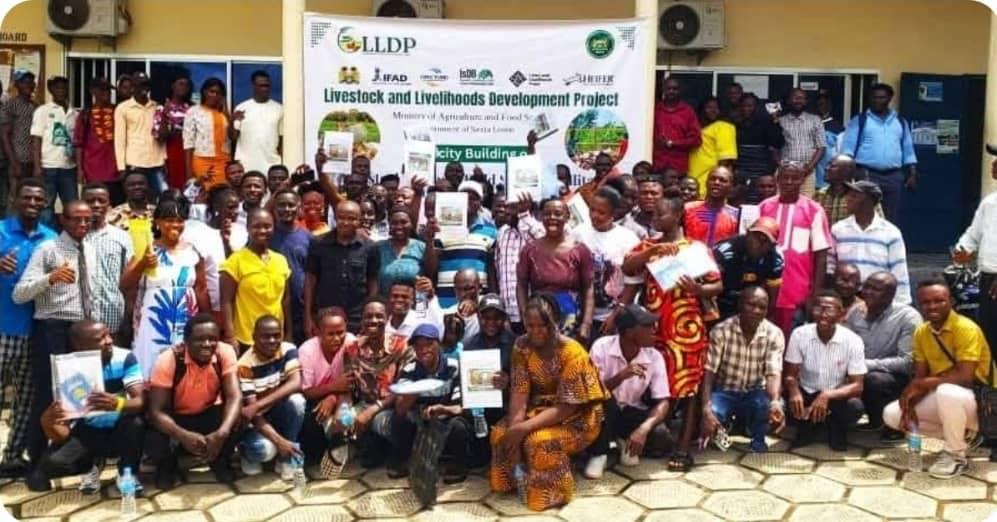
FREETOWN — The Ministry of Agriculture and Food Security (MAFS) has trained over 150 Livestock Farmer Field School (L-FFS) facilitators across 11 districts in a major push to improve livestock farming and boost rural livelihoods.
The training was conducted through the Livestock and Livelihoods Development Project (LLDP) in a two-week intensive programme aimed at equipping facilitators with practical knowledge to help farmers improve animal health, strengthen husbandry practices and increase productivity.
The exercise was held in two sessions. The first session, held in Bo from October 12 to 17, brought together facilitators from Bo, Moyamba, Pujehun, Kenema and Kailahun. The second session was held in Makeni from October 19 to 24 for participants from Bombali, Port Loko, Koinadugu, Kono, Tonkolili and Falaba.
Participants were trained in animal husbandry, livestock health management and participatory teaching methods, combining field demonstrations, group work and practical problem-solving to prepare them for community-level engagement.
Under the Farmer Field School approach, livestock farmers will be encouraged to learn by doing — testing improved practices on their own animals, sharing experiences and developing local solutions.
The facilitators are now expected to establish and lead L-FFS groups in their respective districts to cascade the knowledge to farming communities.
Speaking at the opening of the Bo session, Deputy Minister of Agriculture and Food Security, Ing. Bryan Smart-Kanu, linked the initiative to the Government’s Feed Salone agenda, stressing the need to cut down on food imports.
“A country can never be independent if we continue to get our feeding from overseas,” Smart-Kanu said, urging the facilitators to put their new skills into practical use in their communities.
The initiative is expected to help farming households improve livestock health, boost production, increase incomes and enhance access to nutritious food, while supporting Government’s broader efforts to strengthen domestic food production.
Contact: Daily Scope Newspaper – dailyscopemedia@gmail.com