By Saidu Jalloh, Reporter, D.S
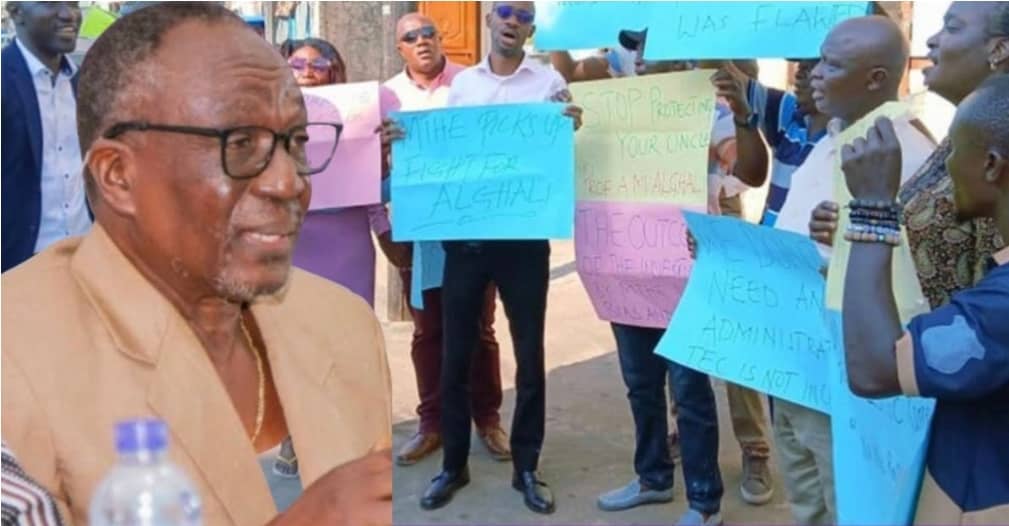
Staff members of the Tertiary Education Commission (TEC) in Sierra Leone have staged a protest at their office, demanding the resignation of Chairman Prof. A.M. Alghali over serious allegations of financial misconduct, including charges of “double-dipping” that purportedly total over Le 2 billion.
The demonstration follows findings from a recent investigation by the Ministry of Technical and Higher Education (MTHE), which scrutinized claims of misconduct centered on Prof. Alghali. Staff, including Admin Manager Josephus Sawyer, accuse him of receiving salaries simultaneously from both TEC and Njala University, where he previously served as Vice-Chancellor. This alleged practice violates public service regulations, they assert.
“We have clear evidence showing that Prof. Alghali has been collecting both his TEC salary and an additional salary from Njala University since 2019,” Sawyer stated. “The total amount he has received exceeds 2 billion Leones.”
In response, Prof. Alghali has refuted the allegations, claiming he is entitled to a pension from his tenure at the university. “According to the TEC Act, I am entitled to a pension after retirement,” he told Truth Media. “So, where is this ‘double-dipping’ coming from?”
Despite his denials, TEC staff argue that evidence of multiple payments for leave allowances after his retirement indicates ongoing financial impropriety. “Receiving leave allowances multiple times after retirement is not an oversight; it’s clear corruption,” Sawyer added.
The protest is not solely about financial issues; employees have also criticized Alghali’s leadership style, describing a toxic environment marked by intimidation and an overreach of authority. Executive Secretary Dr. Saidu Kanu disclosed that Prof. Alghali often dominates management meetings, undermining his role. “I have been reduced to merely writing letters under his directive,” Kanu lamented. “This violates the TEC Act of 2025, which prohibits one individual from controlling the Commission’s activities.”
In addressing the allegations, the Ministry of Technical and Higher Education stated its investigation found no supporting evidence for most claims against Alghali, although it did identify “historic systemic governance and fiduciary weaknesses” within TEC. Recommendations for a review of TEC’s management processes were made, but TEC staff expressed skepticism about the investigation’s thoroughness. “The Ministry’s review failed to consider the evidence we provided,” Sawyer asserted.
Concerns also extend to resource shortages at TEC, particularly affecting female staff members. Nadia Parkinson, Manager for Accreditation of Program, New Institutions, and Legislation, recounted how Prof. Alghali’s remarks have created a hostile work environment. “He has used foul language against us, berating us in meetings,” she said.
In defense, Prof. Alghali dismissed allegations of misconduct and asserted his leadership role. “The staff feel they own the Commission, but that’s not the case,” he claimed. “My role is to oversee the running of TEC.”
As tensions rise, the allegations have sparked broader discussions about governance and accountability within Sierra Leone’s education sector. With Parliament postponing a scheduled meeting on the matter, TEC staff have vowed to persist in their protests and call for additional investigations.
“We want to restore integrity and professionalism to the Commission,” said Emmanuel Thinka-Kamara, Manager of Academic Audit and Institutional Affairs at TEC. “We cannot continue to work under these corrupt practices. We urge Parliament to act urgently on this issue.”
As the controversy unfolds, the response from the government, the Anti-Corruption Commission (ACC), and Parliament to these escalating allegations remains to be seen.
For inquiries, please contact the Daily Scope Newspaper at dailyscopemedia@gmail.com.