By Joseph Momoh, Daily Scope Reporter
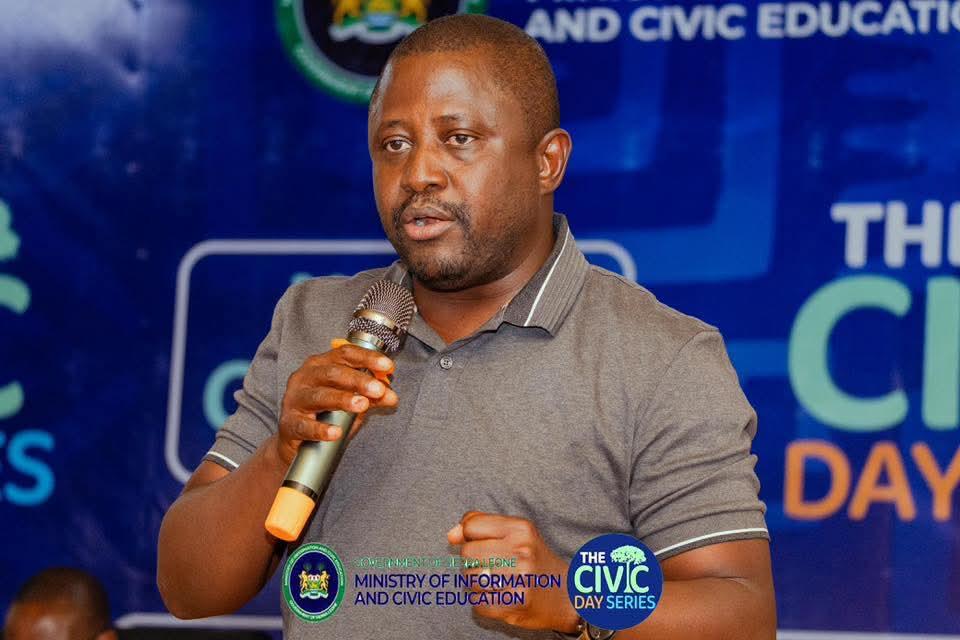
The Attorney General and Minister of Justice, Alpha Sesay Esq., addressed the Kono Civic Day Series Conference hosted by Minister of Information and Civic Education, Chernor Bah. During the event at the Kono District Council Hall, he provided an in-depth overview of Sierra Leone’s constitutional review process and the proposed Electoral Reforms Constitution Amendment Bill currently under consideration in Parliament.
In his presentation, Attorney General Sesay traced the history of Sierra Leone’s constitutional evolution, noting the establishment of a one-party state under the 1978 Constitution, which was replaced by the multiparty system in 1991 shortly before the civil war began. Following the conflict, the Lomé Peace Agreement of 1999 called for a comprehensive review of the 1991 Constitution, leading to the formation of the Truth and Reconciliation Commission (TRC). The Commission identified governance weaknesses and recommended a broad reform process.
Acting on these recommendations, former President Dr. Ahmad Tejan Kabbah issued a White Paper committing to constitutional reform and appointed a committee chaired by Dr. Peter Tucker to undertake the task. This committee’s report was subsequently submitted to former President Dr. Ernest Bai Koroma.
In 2013, President Koroma established the Justice Edmond Cowan Constitutional Review Committee, which included over 80 members from various sectors, such as political parties, civil society organizations, youth groups, and market women. The committee conducted extensive consultations, including over 10,000 public engagements, 150 position papers, and 180 direct stakeholder dialogues.
The committee submitted its report in June 2017, with the government partially accepting and rejecting its recommendations. In 2021, President Julius Maada Bio issued another White Paper, integrating provisions from the Gender Equality and Women’s Empowerment (GEWE) Act into the proposed new Constitution.
The Attorney General also detailed the establishment of a Tripartite Committee following the 2023 National Peace and Unity Agreement, which resulted in 80 recommendations. Non-entrenched provisions have already been presented in Parliament as electoral reforms for the upcoming 2028 general elections, while entrenched provisions will undergo a broader constitutional review leading to a national referendum.
One significant proposal highlighted includes the move toward Proportional Representation (PR) in elections. The Bill aims to repeal Section 38A, which grants temporary authority for PR, and amend Section 74(1)(b) to permit a specific category of Members of Parliament to be elected through this method, with further modalities to be decided by Parliament.
During his visit to Kono, the Attorney General engaged with key stakeholders in the justice sector, including magistrates, prosecutors, defense lawyers, police officers, and court staff. They discussed challenges affecting access to justice and explored strategies to strengthen the judicial system.
Additionally, the Attorney General visited the Safadu Correctional Service Centre, commending the management and staff for their inmate rehabilitation efforts and initiatives to reduce reoffending. He interacted directly with male and female inmates to gain insights into their experiences with the criminal justice system and prison conditions, expressing satisfaction with the facility’s cleanliness and the management’s vision to transform it into a model institution for correctional reform in Sierra Leone.
For more information, contact Daily Scope Newspaper at dailyscopemedia@gmail.com.