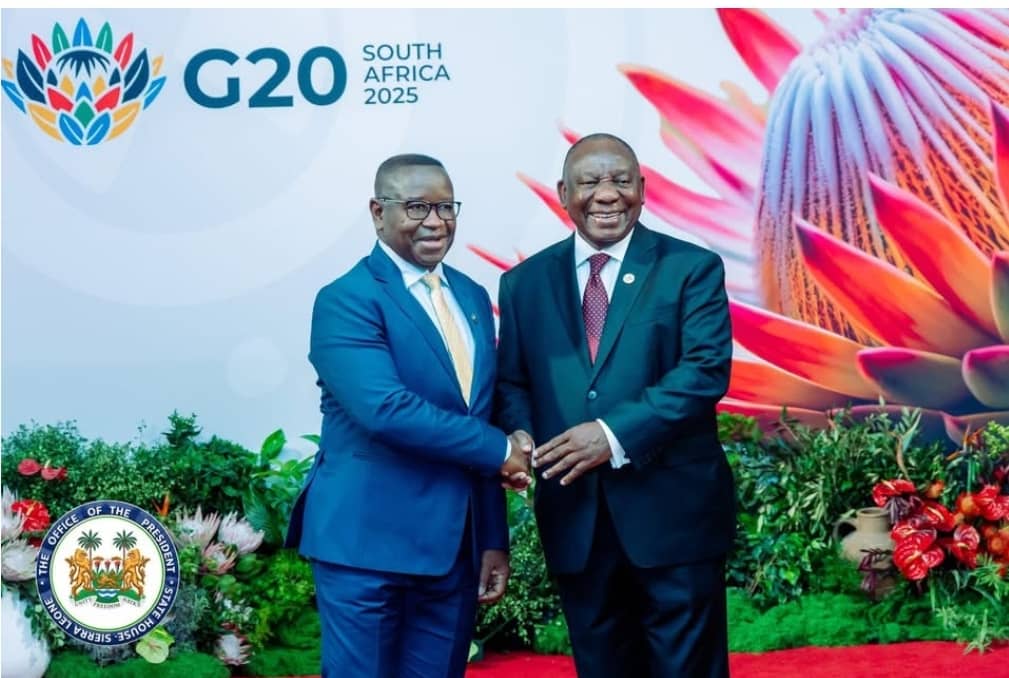
By Saidu Jalloh, Reporter D.S
Johannesburg, South Africa – November 2025 Sierra Leone’s President Julius Maada Bio, also Chair of the ECOWAS Authority of Heads of State and Government, emphasized the critical role of Africa’s minerals in the global clean-energy transition during the 2025 G20 Summit. He proposed the establishment of a G20–Africa Compact focused on critical minerals.
In his address, President Bio spotlighted Africa’s vast mineral wealth, noting that the continent holds nearly one-third of the world’s critical minerals essential for renewable energy technologies, advanced manufacturing, and artificial intelligence. He highlighted Sierra Leone’s significant mineral resources, including iron ore, rutile, bauxite, and diamonds, warning that without systemic changes, Africa may continue to supply raw materials while receiving minimal economic benefits.
“For too long, our resources have fueled global industries while our nations captured the least value,” Bio stated. “This generation must break that cycle, starting with a G20–Africa Compact anchored in justice.”
His proposal reflects a growing consensus that the global energy transition must be equitable and inclusive. The compact aims to establish transparent contracts, attract investments for mineral processing, and create fair revenue models prioritizing African development and job creation. Bio stressed the necessity for Africa not just to supply minerals, but to pursue local processing and refining to spur job creation and industrial growth.
“It is not enough for Africa to supply the minerals. We must process them, refine them, and benefit from them,” he asserted.
While the summit’s overarching theme focused on trade, finance for development, and debt burdens, Bio strategically redirected attention to the geopolitical significance of Africa’s mineral resources. He argued that the clean-energy future hinges on Africa’s contributions and insisted that the continent must partake in the economic value derived from this transition.
Bio also addressed larger economic challenges facing African nations, such as slowing global growth and rising debt burdens. He reiterated Sierra Leone’s calls for accelerated debt restructuring and increased Special Drawing Rights through regional development banks to support long-term financing for infrastructure and trade.
On climate change, he reminded global leaders that Africa disproportionately shoulders the climate burden, contributing less than four percent to global emissions. Drawing from personal experience, he discussed the impact of climate change in Sierra Leone, where communities face flooding and disrupted agriculture from erratic weather patterns. He renewed his call for a West Africa Climate Adaptation Acceleration Facility to tackle urgent issues related to food security and coastal protection.
Finally, Bio stressed the need for ethical, inclusive, and equitable governance of artificial intelligence (AI). While acknowledging the potential of AI for development in Africa, he cautioned against deepening technological inequalities and emphasized the need for global frameworks ensuring accessibility for all.
President Bio concluded by urging G20 leaders to commit to a new development compact based on fairness and shared prosperity. He reaffirmed that the proposed G20-Africa Compact on Critical Minerals presents not only an important economic opportunity but also a chance to rectify historical imbalances and secure a just future for the continent.
For more information, please contact Daily Scope Newspaper at dailyscopemedia@gmail.com