By Joseph Momoh, Daily Scope Reporter
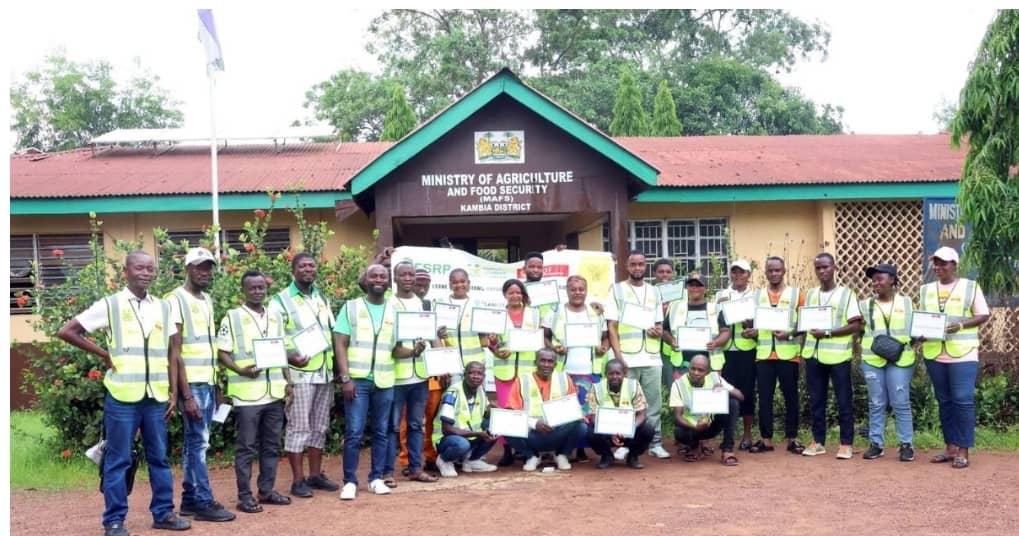
The Ministry of Agriculture and Food Security has completed the second phase of a training programme to equip extension officers with tools to help rice farmers adapt to climate change in Kambia and Tonkolili districts.
A total of 40 extension officers took part in the week-long exercise, organized under the Sierra Leone Rice Systems Capacity Strengthening Project of the Food System Resilience Program.
Officials said the training was designed to move beyond theory and give officers practical skills they can transfer directly to smallholder farmers. Sessions combined classroom instruction with field demonstrations on climate-smart agriculture, soil fertility management, integrated pest management, and water conservation.
Participants were also taken through demonstration plots where they learned improved practices such as better seed selection, timely planting, and micro-dosing of fertilizer — techniques aimed at improving yields under erratic weather conditions.
Project coordinators described the initiative as a bridge between national agricultural policy and community-level implementation. After the training, the officers are expected to set up farmer field schools, run on-farm demonstrations, and provide targeted support to farmers in their districts.
Trainees said the programme strengthened their capacity to advise farmers on adjusting cropping calendars and adopting affordable soil management methods to cope with droughts and floods.
Mohamed Deen Rogers, a project representative, stressed the need for follow-up to ensure knowledge reaches the farm level through community outreach and practical demonstrations.
Officials noted that stronger extension services can deliver both economic and environmental gains by raising productivity, increasing incomes, and reducing climate-related losses. They highlighted the importance of the intervention in the Northern and North Western regions, where rice is central to food security and livelihoods.
The second phase was funded by the Japanese Social Development Fund through South-South Cooperation. Implementers said partner support and inter-agency collaboration have been key to expanding capacity-building in rural areas.
Next steps, according to MAFS, include farmer outreach, monitoring of demonstration plots, and refresher training for officers. The project will also track adoption rates and productivity changes to measure impact.
The long-term goal is to integrate these improved extension approaches into the ministry’s systems so that smallholder rice farmers continue to benefit after the project ends.
For more information, contact Daily Scope Newspaper at dailyscopemedia@gmail.com