By Kadijatu Bangura, Staff Reporter
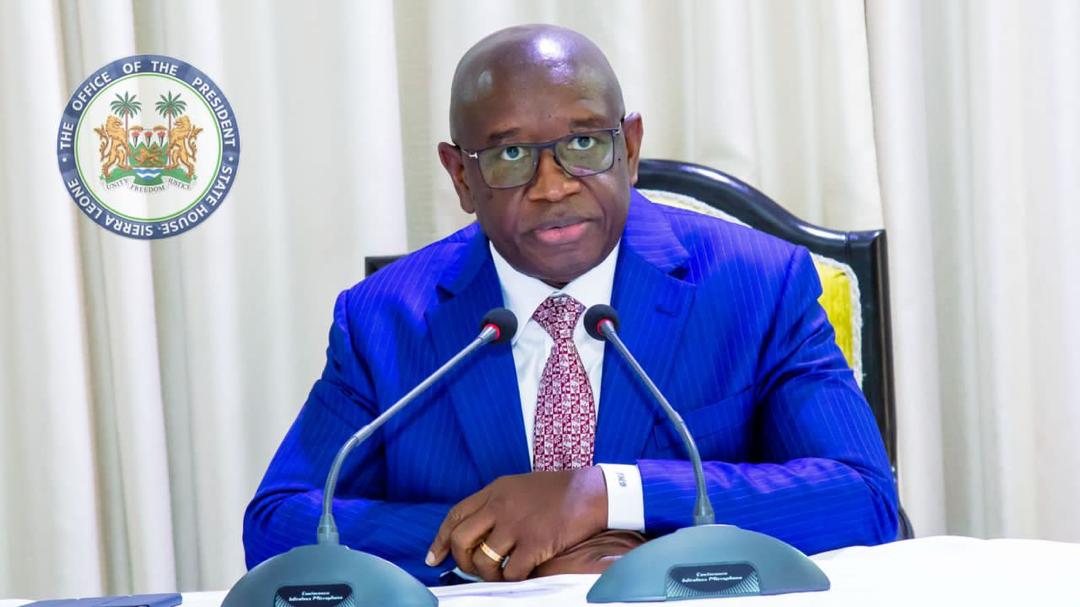
President Julius Maada Bio says food security, education, health and energy remain the pillars of his government’s transformation agenda, declaring that “a nation that cannot feed itself cannot truly call itself free.”
The goal, Bio said, is simple: “Sierra Leonean farmers will be able to use our fertile land to feed Sierra Leonean families at prices our people can afford.”
However, he acknowledged that global shocks have made that goal harder. Government is now “narrowing the deficit and managing inflation with greater seriousness and consistency” while the IMF programme remains on track. Moreover, partnerships with the World Bank, African Development Bank and EU continue to support stability and social protection.
To cushion households, government has rolled out strategic reserves of essential commodities and expanded aid for vulnerable families. Cash transfer and cash-for-work programmes are reaching communities “where the pressure is greatest.”
“These measures matter. They provide relief,” Bio said. “Nevertheless, relief is not the same as transformation.”
The deeper response, he argued, is to build an economy that produces more, powers itself reliably, creates jobs at scale, and trades from strength. Under the Feed Salone programme, farmers are getting improved seeds, financing and market access. Moreover, agribusiness investment is expanding, the rice import bill is easing, and cocoa exports are strengthening reserves.
This year, government will complete bridges and feeder roads to link farmers to markets. Work will also advance on the rice clusters in Tormabum and Bonthe, and on new financing facilities to unlock capital for farmers and agribusinesses.
On education, Bio noted more children are in school today than at any point in the nation’s history under Free Quality Education, backed by improved teacher training and a focus on girls. “Access without quality is not enough,” he said, “and no country can move forward while leaving half of its talent behind.”
Meanwhile, in health, primary care facilities have expanded, more health workers have been trained and deployed, and epidemic preparedness has strengthened. Government hospitals now have CT scan facilities, modern ultrasound services, and enhanced maternal care. The new burns and reconstructive unit at Connaught Hospital, he added, “is restoring hope and healing.” Notwithstanding these gains, Bio said, “access to health care will always be a right.”
However, energy access remains the clearest strain on citizens. Global instability, including conflict in the Middle East, has driven up petrol prices and raised the cost of power for homes and businesses. “A student without light loses hours of study. A clinic that relies on a generator operates under constant pressure. A small business weighed down by diesel costs cannot grow,” Bio said. “A country that cannot guarantee power cannot industrialize as it must.”
As recently as 2018, he noted, reliable electricity was largely limited to Freetown, Makeni and a few urban centres.
For more information contact Daily Scope Newspaper at dailyscopemedia@gmail.com