By: Saidu Jalloh, Daily Scope
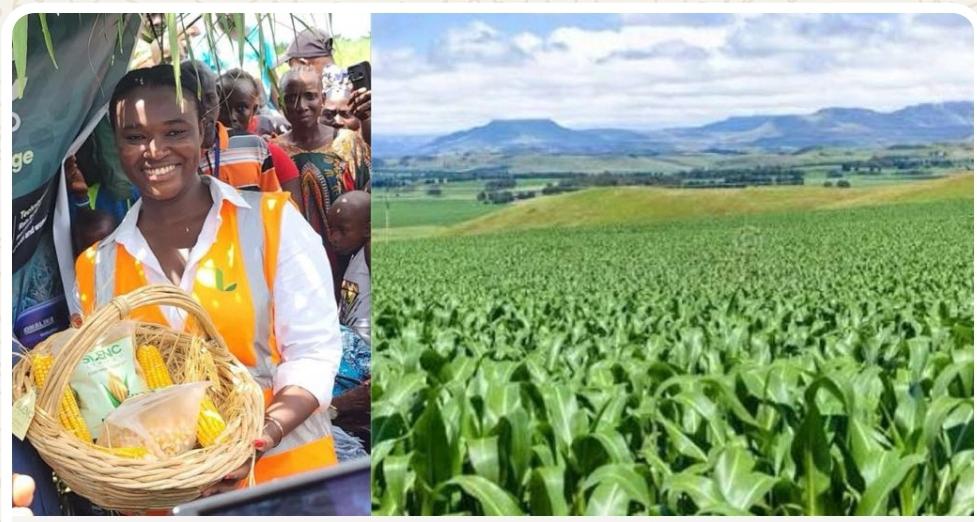
What began as a five-hectare maize plot has grown into one of Sierra Leone’s standout youth-led agribusinesses, with Computer Science student Sherilyn Cowan now cultivating 150 hectares and employing more than 200 young people.
Cowan, who has balanced her studies with maize farming for five years, supplies a critical input for the country’s poultry sector. Her operation took a decisive turn after support from the Food System Resilience Program, an initiative designed to lift agricultural productivity and pull more young people into commercial farming.
The shift became visible in 2024. As demand from poultry farmers climbed, Cowan saw room to scale but lacked the inputs to meet it. FSRP stepped in with improved maize seeds to cover 60 hectares. Working with SLENC, a women-led collective she is part of, Cowan put the land under cultivation and recorded a sharp jump in output.
“The support moved us from small-scale to commercial,” Cowan said. Before the intervention, her annual planting averaged five hectares.
FSRP returned in 2025 through its Matching Grant Scheme. The funding allowed Cowan and her team to expand acreage further and add processing capacity. The group now farms 150 hectares and plans to convert this season’s harvest into poultry feed, capturing more value on-farm.
The enterprise currently employs over 200 young people. Women make up roughly 70 percent of the workforce, handling roles from field operations to processing. Beyond direct jobs, the expansion is raising maize volumes, boosting household incomes, and strengthening local food and nutrition security.
Cowan’s trajectory underscores a wider trend: targeted financing and input support can unlock agribusiness as a serious career path for youth and women. Her operation feeds into poultry value chains, reduces pressure on imports, and keeps revenue circulating in rural communities.
The Food System Resilience Program says it will continue backing young entrepreneurs nationwide, positioning agriculture not as subsistence activity but as a route to economic empowerment and a more resilient national food system.
For more information contact Daily Scope Newspaper at dailyscopemedia@gmail.com