By Saidu Jalloh, Daily Scope Reporter
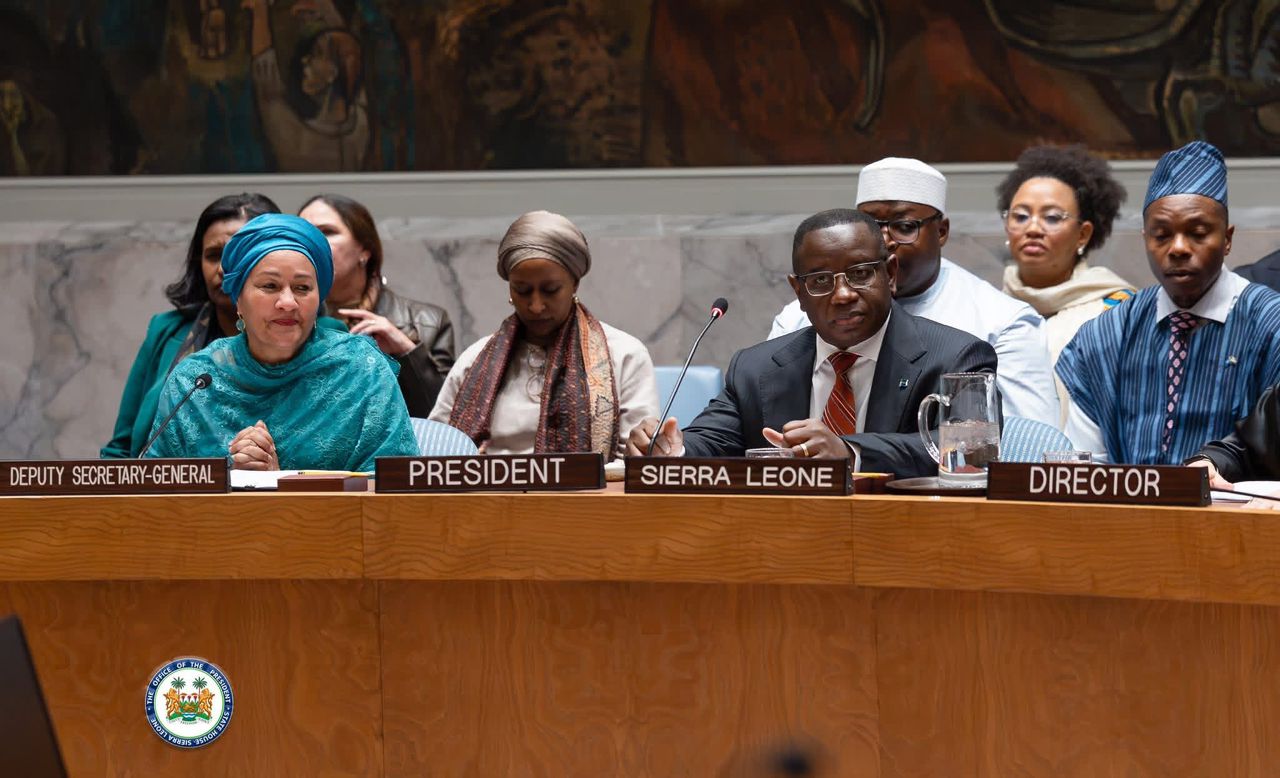
UN Headquarters, New York, USA – November 17, 2025 – His Excellency Dr. Julius Maada Bio, President of Sierra Leone and Chair of the ECOWAS Authority, led a high-level United Nations Security Council debate today on “Threats to International Peace and Security: Conflict-Related Food Insecurity.”
During his address, President Bio emphasized the alarming trend of using hunger as a weapon of war, calling for urgent international action to prevent the deliberate starvation of civilians. He stressed that such conduct is prohibited under international law and amounts to war crimes.
Highlighting the humanitarian crises resulting from ongoing conflicts in regions such as Gaza, Sudan, Haiti, Ukraine, and the Sahel, President Bio described starvation as a “slow, silent, corrosive” violence that exacerbates instability and fuels conflict.
He articulated three key messages: that starvation constitutes a crime rather than collateral damage, that food insecurity is both a driver of conflict and a peacebuilding necessity, and that sustainable peace demands investment in agricultural resilience, markets, and human capital, particularly among women and youth.
President Bio showcased Sierra Leone’s Feed Salone Initiative as a compelling national example of how food security is essential to the nexus of peace and development. This four-pillar program focuses on production, resilience, market development, and human capital to enhance productivity, reduce import reliance, and establish climate-smart systems that promote stable livelihoods.
At the regional level, he pointed to ECOWAS efforts to incorporate food security into frameworks for peacebuilding, early warning systems, and trade, specifically mentioning the expansion of the ECOWAS Food Security Reserve and the ECOWARN early warning network.
In his call for accountability, President Bio proposed six actionable steps for the global community: protect food systems in conflict regions, institutionalize early-warning systems, ensure unhindered humanitarian access, promote accountability for starvation-related crimes, connect peacebuilding financing to agriculture and livelihoods, and empower women and youth in agricultural value chains.
“Africa seeks partnership, not sympathy,” President Bio reiterated, stressing the continent’s vast uncultivated arable land and innovative potential among its youth. He concluded by urging the international community to ensure that “no child is starved into submission, no harvest held hostage, and no community driven to violence by hunger,” aligning moral conscience with international law and collective action.
For further information, please contact Daily Scope Newspaper at dailyscopemedia@gmail.com.